













Soft News




The Exhibition "Broken" at Palazzo Strozzi in Florence
A new exhibition at Florence’s Palazzo Strozzi explores research, restoration and the creative potential of fragmentation
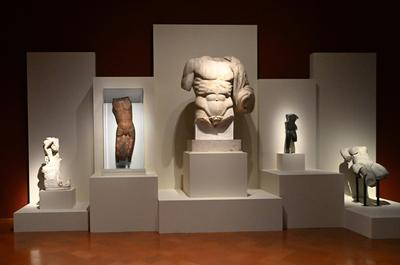
The enduring power of the fragment is at the heart of Broken, a new exhibition at Palazzo Strozzi in Florence through Jan. 24. Following exhibitions devoted to Beato Angelico and Rothko, the show is the result of years of research, restoration and engagement with contemporary art.
Conceived by American Curators C. D. Dickerson and Andrew Sears of the National Gallery of Art in Washington, where the exhibition will move on March 3, the show brings together 80 works spanning from ancient Egypt to the present day. They have been damaged or mutilated by wars, iconoclasm, neglect and climate-related disasters such as the 1966 flood in Florence.
“It’s a special exhibition because, for the first time, it brings together five millennia and five continents of sculpture,” says Arturo Galansino, Director General of the Fondazione Palazzo Strozzi. “But it tells a different kind of history because everything is viewed through the lens of fragmentation, or rupture.”
For Luigi De Siervo, President of the Fondazione Palazzo Strozzi, “Broken is perhaps the boldest experiment of our 20 years of stewardship, because in a world that tends toward aesthetic perfection, putting an apparent imperfection at the center is truly a challenge to the times we live in.”
Works by some of the great Master of Art History, including Giovanni Pisano, Michelangelo, Antonio Canova and Auguste Rodin, are displayed alongside sculptures by contemporary artists such as Louise Bourgeois, Huma Bhabha, Robert Gober, Francesco Vezzoli and Danh Vo, who have made the fragment a starting point for new forms of expression.
For the exhibition, Palazzo Strozzi is also presenting a new installation by Dutch artist Mark Manders, conceived for the Renaissance courtyard.
As soon as visitors enter, they encounter his monumental sculpture Tilted Head, which appears fragile, unfinished and as though molded from clay. The work is actually a resin cast of the original clay model, blurring the boundary between appearance and reality. It is accompanied by a series of pieces of furniture made at 88% of their actual scale, an almost imperceptible reduction that nonetheless creates a subtle sense of disorientation.
Pages from a newspaper created by the artist also appear throughout the installation, used as coverings or simply laid across the objects.
Equally striking in the exhibition’s final room is Incarnator by American artist Paul Pfeiffer, which explores how the media transform athletes and celebrities into collective images, objects of desire and figures of worship.
The series presented here focuses on Justin Bieber, a global icon of the digital age. Pfeiffer commissioned sculptors working in Mexico, Spain and the Philippines to create his likeness, places shaped by different colonial histories and the spread of Catholicism. Heads, torsos, arms and legs are carved and painted separately using techniques associated with the production of sacred images. In particular, Pfeiffer draws on the work of encarnadores, artisans who specialize in making wood appear like living flesh.

The Exhibition "Broken" at Palazzo Strozzi in Florence


Also intriguing is Meat cables, a series by Vietnamese artist Danh Vo that combines fragments of 16th-century cupids and Roman marble sculptures with contemporary elements. In one case, the fragments are placed inside a suitcase; in the other two, they are supported by construction lumber and a fragment of a column. The juxtapositions evoke the circulation of artworks and the formation of European collections, as well as forced displacement and the trafficking of human bodies.
Among the classical works on display are a fragment showing the nose and lips of the Egyptian pharaoh Akhenaten (1350 B.C.), a head of the goddess Aphrodite dating to the second century B.C., the remains of Giovanni Pisano’s funerary monument to Margaret of Brabant (1312–14), a female nude study by Michelangelo, and two evocative plaster heads by Antonio Canova damaged in World War I bombings.
There are also several works looted from Cambodian temples during the years of Pol Pot’s regime, as well as a bust of Mussolini by Adolfo Wildt from the Casa del Fascio in Milan, riddled with bullets fired by partisans after the Liberation.
“Throughout the millennia, there has always been a tendency to erase and destroy symbols of political and religious power,” Dickerson says. What visitors see at Palazzo Strozzi “brings us back to the present and shows us that the present comes after a long and universal history,” he adds. “Images have always possessed great power, and they also attract destructive forces.”
“Fragmented or mutilated sculptures,” says Kaywin Feldman, Director of the National Gallery of Art in Washington, “reflect our time, a world marked by upheaval and uncertainty. Yet these forms also suggest a certain resilience: the possibility that beauty and meaning can emerge from what has been broken apart.”
— ©️ ALL RIGHTS RESERVED.
