













Soft News




A group of retirees is keeping an old tradition alive at the only saltworks of its kind still operating in Italy. “My father and grandfather did this work. For us, it’s a passion.”
Cervia (Ravenna)
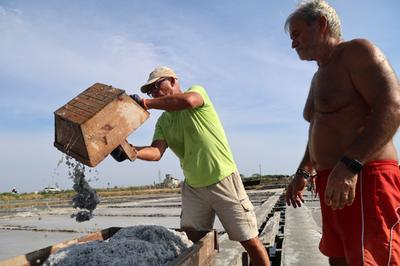
At Cervia, salt is still harvested by hand, using the same methods and wooden tools employed in the 18th century. Sea water, sun and wind do the rest — just as they have for centuries.
In the early 1990s, near Ravenna, a group of volunteers rescued an abandoned salt pan and brought it back to life, preserving a tradition that has disappeared almost everywhere else. Today, it is the only multiple-harvest saltworks still operating in Italy, producing salt as it was made before modern machinery took over in the late 1950s, with the harvest collected once a week.
The result is a prized food product known as “Cervia Sweet Salt,” a name once coined by the legendary Italian food and wine critic Luigi Veronelli to describe its complete lack of bitterness.
If the salt ponds of this Romagna town is also part of Slow Food Presidio and a FAI Place of the Heart, the credit goes to the Civiltà Salinara cultural group. Its roughly 50 volunteers, all retirees, work between the Cervia Salt Museum and the Camillone Saltworks, which serves as their open-air workshop.
“This was the only multiple-harvest saltworks left in Cervia, out of the 150 that existed before 1960, when machineries were introduced,” says the Association’s President, Oscar Turroni, 78. “At the end of the 1980s, we decided to clean it up and get it working again.”
And that is exactly what they did. First came the Civiltà Salinara Group, followed by the Salt Museum, which was established in the historic Salt Warehouse of the same name. Today, the saltworks produces around 600 quintals, or 60 tons, of salt over the summer. Properly packaged in bags, distributed to museum visitors in exchange for a voluntary donation. The rest, Turroni says, goes to the Cervia Saltworks Nature Park, where it is sold.
Getting to that final product, however, means hard physical work for the volunteers under a merciless sun, driven by their passion for an ancient craft that is at risk of disappearing.
“We use the same wooden tools that were used in the past, from the panoncello, the shovel used to harvest the salt, to the gavero, a toothless rake used to push it from one side of the pond to the other. Then there is the paniera to carry the salt and the carriolo to take it to the drying yard, where it is piled up,” explains Claudio Ridolfi, 71, who worked as a tax adviser before retiring.
The group’s work — carried out by around a dozen lifelong friends, many of them the children or grandchildren of former salt workers — begins in April. The ponds are drained and their banks restored, while the mud at the bottom is compacted with wooden rollers before seawater is allowed to flow back in.



“The first evaporation ponds are terraced to make it easier for the water to move through the system,” Ridolfi explains. “In the salt ponds, we need to reach a sodium chloride concentration of 94–95%. This is achieved as the bitter salts settle in the first ponds.”
All this takes place in extreme conditions, particularly during a summer marked by one heat record after another.
“It is physically demanding work, and we do it entirely by hand,” Ridolfi says. “In the afternoon, temperatures reach 40°C, the mud can reach 50°C, and there isn’t even a tree here to give us some shade.”
So why do they do it?
The answer is simple: passion.
“My father was a salt worker, and so was my grandfather. Years ago, a distant relative suggested I join the group, and I accepted. Then it got into my blood. We are among friends, we chat, we go out for something to eat together. I work here at the saltworks and my wife works at the Salt Museum. But above all, seeing that we can still produce salt the way our grandparents did is immensely satisfying.”
He also stresses the importance of their shared identity as people from Cervia.
“It’s about being from Cervia. We’ve known each other since we were children, when we lived inside the town walls. Fifty years later, we found ourselves back together, working as salt makers.”
Ridolfi also points out that even the name of his hometown is closely linked to salt.
“A pile of salt,” he explains, “is acervum in Latin, which is where Cervia comes from — although Catholic tradition says the name derives from a deer that knelt before a bishop.”
One thing is certain: salt production in this area dates back to Roman times, as demonstrated by the remains of a sluice and other artefacts dating to the third century BC.
Throughout history, the industry retained such importance that, under Papal rule, the town was literally moved.
“In 1697, Cervia was demolished and rebuilt closer to the sea, in a more suitable location,” explains local historian Renato Lombardi. “The aim was to make salt production more efficient.”
The tools still used today at the Camillone saltworks are the same ones used in the 18th century.
— © ALL RIGHTS RESERVED.
